Byzantine Binding
Byzantine binding is a complex traditional book structure, distinguished by its flat extended spine and chain stitch sewing.
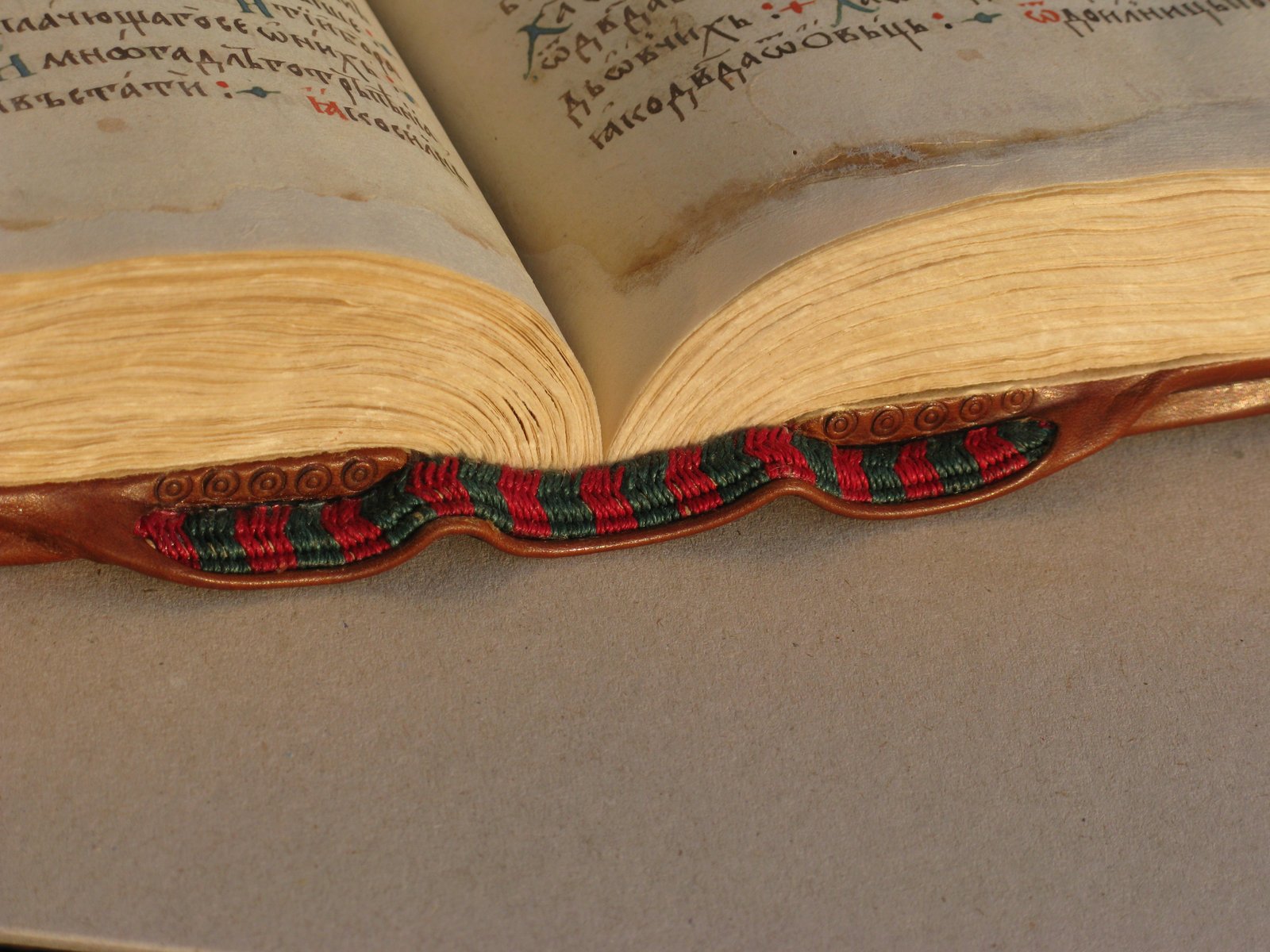
Byzantine binding is a complex structural whole with its own particular logic of construction, fundamentally different from bindings made in the West during the same period, and especially from modern bindings. One of its basic characteristics is its distinctive form: an elongated, flat spine without the transverse raised bands typical of Western bindings. The book block is sewn with a chain stitch, starting from the board, in two separate halves that are ultimately joined into a single unit with the same thread used for sewing.
This elongation results, on the one hand, from the lacing of the headband, which had both structural and decorative functions. It extended not only along the edge of the book block where sewing is performed, but also partly across the boards. On the other hand, the elongated spine follows from the fact that the boards of a Byzantine binding were the same height and width as the book block, with no projecting edges. The projecting edges of Western bindings made it possible to accommodate the headband without elongating the spine.
Because of this construction, Byzantine bindings were always stored lying on their lower cover. This type of binding was used on Serbian books until the end of the seventeenth century. Beyond Serbian lands, the Byzantine manner of bookbinding was also developed across other Eastern Orthodox regions: in Georgia, Syria, Cyprus and other islands, Greece, Mount Athos, distant Russia, and the Monastery of Saint Catherine on Mount Sinai. Armenia likewise belonged to this shared bookbinding culture.